What Quality Documents Buyers Should Ask for in Tinplate Procurement
Why Quality Documents Matter More Than Many Buyers Realize
In tinplate procurement, buyers often focus first on price, specification, and lead time. Those things matter, but another important area is sometimes handled too casually:quality documents For serious industrial buyers, documentation is not paperwork for its own sake. It is part of supplier discipline.Good documentation helps buyers:
- verify what was supplied
- improve receiving confidence
- reduce internal uncertainty
- support repeated procurement
- strengthen traceability
- evaluate supplier reliability over time
In recurring industrial procurement, the quality of documentation often says a lot about the quality of the supplier’s process. A supplier that handles documentation clearly usually handles repeated orders more clearly as well. That is why experienced buyers do not only ask “What is the material?” They also ask “How well is the material documented?”
Documentation Is Part of Procurement Risk Control
Buyers often ask for documents because they want more than a verbal promise. Documentation helps reduce procurement risk in several ways:
- it confirms material details more clearly
- it supports internal quality review
- it improves communication between purchasing and production
- it reduces disputes around repeated specifications
- it gives buyers stronger confidence in repeated supply
For one-time spot buying, weak documentation may create inconvenience. For recurring industrial procurement, weak documentation creates a pattern of uncertainty.That is why serious buyers often evaluate documentation not as an isolated task, but as part of the supplier’s overall order discipline.
One of the First Things Buyers Want: Clear Material Identification
A basic expectation in tinplate procurement is that the material should be clearly identified and traceable. That means buyers usually want enough documentation to understand:
- what specification was supplied
- what order or batch it belongs to
- whether it matches the agreed requirement
- whether the supplier can support the same requirement again later
This matters because many buyers work with:
- repeated dimensions
- recurring SKUs
- repeated production orders
- ongoing long-term supply programs
Without clear material identification, repeated procurement becomes harder to control. A supplier that documents recurring material clearly helps the buyer reduce internal confusion and improve long-term order stability.
Quality Documents Also Help Receiving and Internal Review
Documentation is especially useful when the material arrives and must be reviewed inside the buyer’s operation. Depending on the buyer’s internal process, documents may support:
- receiving inspection
- warehouse release
- internal quality confirmation
- technical review
- repeat-order reference
- supplier comparison for future purchases
This is why some buyers ask for documents not because they distrust the supplier, but because they run a more structured internal process. In these cases, documentation is part of normal industrial procurement discipline. A supplier that supports this well is usually easier to work with in repeated business.
Common Types of Documents Buyers Often Request
While document requirements vary by buyer, application, and internal control system, buyers commonly ask for documents related to areas such as:
Material specification confirmation
Buyers often want documentation that clearly reflects the supplied material against the agreed purchasing requirement.
Inspection or quality-related support
Some buyers want supporting records that help confirm receiving confidence and reduce uncertainty.
Shipment and order-related traceability
In repeated industrial orders, buyers often prefer documentation that helps connect the shipment clearly to the actual order and material requirement.
Supplier-level quality discipline
Sometimes what buyers are evaluating is not only the material, but how seriously the supplier manages recurring quality communication. The exact document list may vary, but the principle is usually the same: buyers want a supplier who treats documentation as part of supply reliability, not as an afterthought.
Why Strong Document Discipline Signals a Stronger Supplier
Documentation often reveals how seriously a supplier manages recurring industrial orders. For example, strong documentation discipline may suggest that the supplier is also stronger in:
- repeated order control
- recurring specification handling
- quality consistency
- communication clarity
- internal process discipline
- long-term supply support
This matters because buyers are not only judging the current shipment. They are also asking whether this supplier looks like a supplier that can support repeated procurement with less risk.In that sense, document quality is not just about compliance. It is also about trust.A supplier that documents clearly is usually easier to trust in recurring industrial cooperation.
What Buyers Should Look for Beyond “Do You Have Documents?”
A stronger document review usually asks not only whether documents exist, but whether they are useful. Buyers often care about whether the documentation is:
- clear
- organized
- consistent
- relevant to the order
- easy to match with actual receiving
- supportive of repeated procurement
This matters because poor documentation can still create confusion even if a document is technically present. The best supplier is often the one that provides documents in a way that actually helps the buyer’s internal process move more smoothly. That is one more reason document handling is part of supplier evaluation, not only post-order administration.
Why Documents Matter Even More in Long-Term Procurement
In repeated industrial procurement, buyers usually want suppliers who become easier to work with over time. Documentation helps support that by making repeated orders:
- easier to verify
- easier to compare
- easier to reference
- easier to manage internally
- easier to repeat with confidence
Over time, this improves:
- procurement continuity
- supplier trust
- internal buyer confidence
- efficiency in recurring order management
That is why documentation becomes more valuable the longer the relationship continues. A weak first document may look small. Weak documentation across ten repeated orders becomes a serious management problem.
Common Buyer Mistakes Around Documentation
Buyers often try to avoid several common mistakes. Waiting until after shipment to think about documents The stronger approach is usually to clarify document expectations before repeated procurement becomes routine. Assuming all suppliers handle documentation equally well In reality, documentation quality often varies a lot and may reflect broader differences in process discipline. Treating documents as separate from supplier evaluation Strong documentation usually supports stronger recurring procurement overall. Not checking whether documents are actually useful internally A document that does not fit the buyer’s receiving or review process may still create unnecessary friction. Underestimating documentation in repeat orders In recurring procurement, documents become part of long-term order memory and traceability. These are practical reasons why serious buyers often ask document-related questions early.
What a Strong Tinplate Supplier Usually Provides Through Documentation
A stronger supplier usually helps buyers by offering documentation that supports:
- clearer material confirmation
- smoother receiving review
- stronger traceability
- better recurring order control
- more organized procurement communication
- stronger long-term supply confidence
This is what many serious buyers want when they ask for quality documents. They are not simply requesting paperwork. They are looking for signs that the supplier is ready for more disciplined industrial cooperation.
FAQ
Why do buyers ask for quality documents in tinplate procurement?
Because documents help confirm material details, support internal review, reduce uncertainty, and strengthen confidence in recurring supply.
Are documents mainly important for first orders?
No. They often become even more important in repeated industrial procurement because they support traceability and recurring order control.
What do quality documents help buyers evaluate?
They help buyers evaluate material identification, receiving confidence, supplier discipline, and long-term procurement reliability.
Why does documentation matter in supplier comparison?
Because strong document handling often reflects stronger communication, better process discipline, and more reliable recurring order support
Should buyers only ask whether documents exist?
No. They should also check whether the documents are clear, relevant, organized, and useful for actual receiving and repeated procurement.
---
Related News
Other news you might be interested in
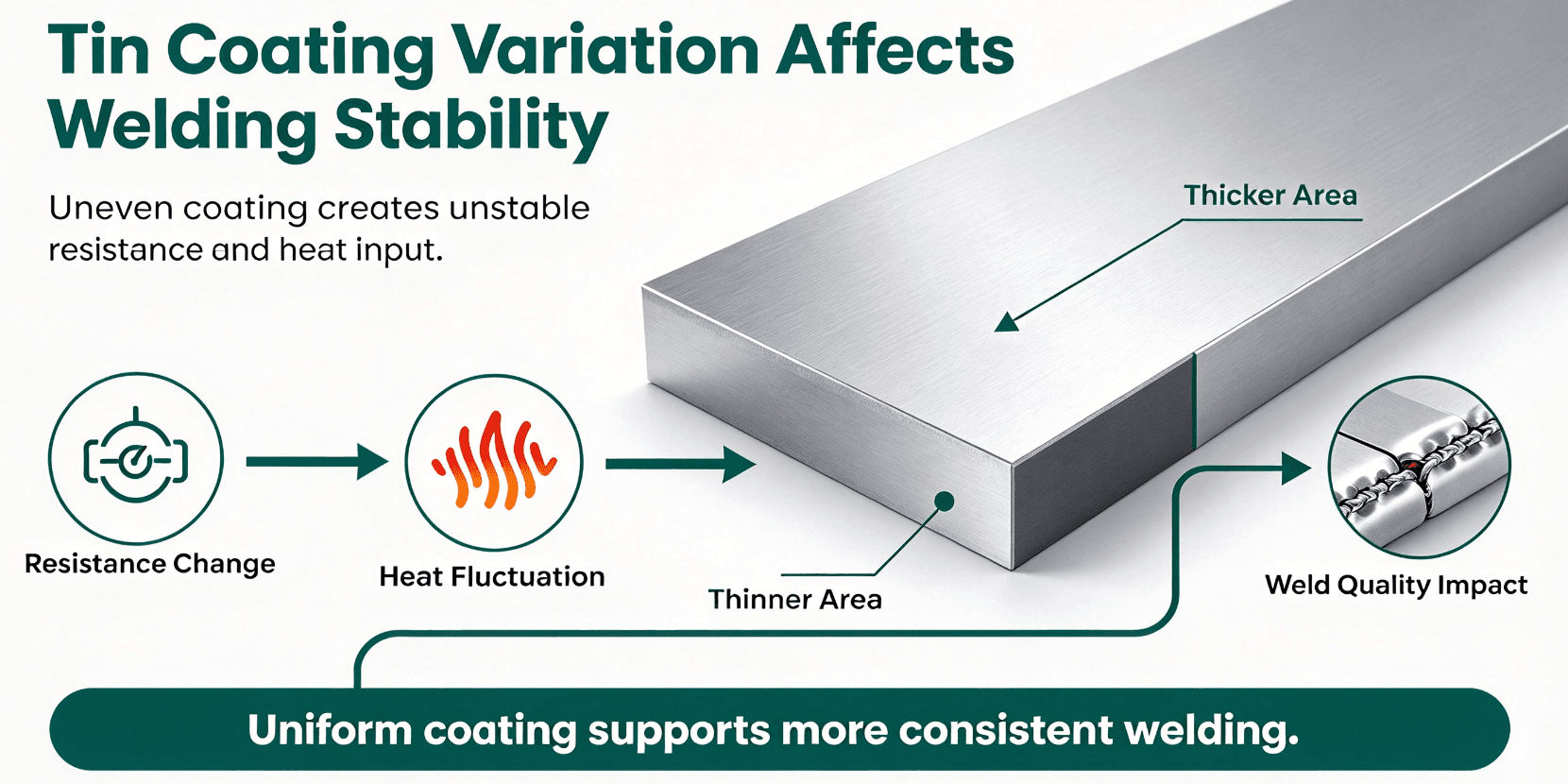
Weld Spatter & Leakage Defects: The Decisive Role of Tin Coating Uniformity in Can Welding Quality
High-speed resistance seam welding is the core forming process for three-piece metal cans. In actual mass production, persistent weld spatter, granular slag residue and hidden seam micro-leakage severely compromise sealing consistency, sterilization resistance and finished product yield. Most manufacturers tend to attribute these defects to unstable current, improper pressure or worn welding wheels. However, industrial verification proves that uneven tin coating distribution on tinplate is the fundamental material-induced root cause of recurring welding spatter and leakage issues.
Low-Earing CA Annealed Tinplate: The Optimal Material for Stable Twist-Off Lid Deep Drawing & High Yield Rate
Twist-off lid manufacturing has extremely strict requirements on material anisotropy and ductility. Different from regular can bodies, twist-off lids undergo complex deep drawing, edge trimming and crimping processes, making them highly sensitive to uneven steel performance. According to actual mass production verification, no alternative tinplate grades can achieve stable forming results for twist-off lid production. Low-earning CA continuous annealed tinplate remains the most suitable and high-performance material dedicated for twist-off lid stamping.
Want to know more?
Get in touch with us for more information about our services and products.