
Weld Spatter & Leakage Defects: The Decisive Role of Tin Coating Uniformity in Can Welding Quality
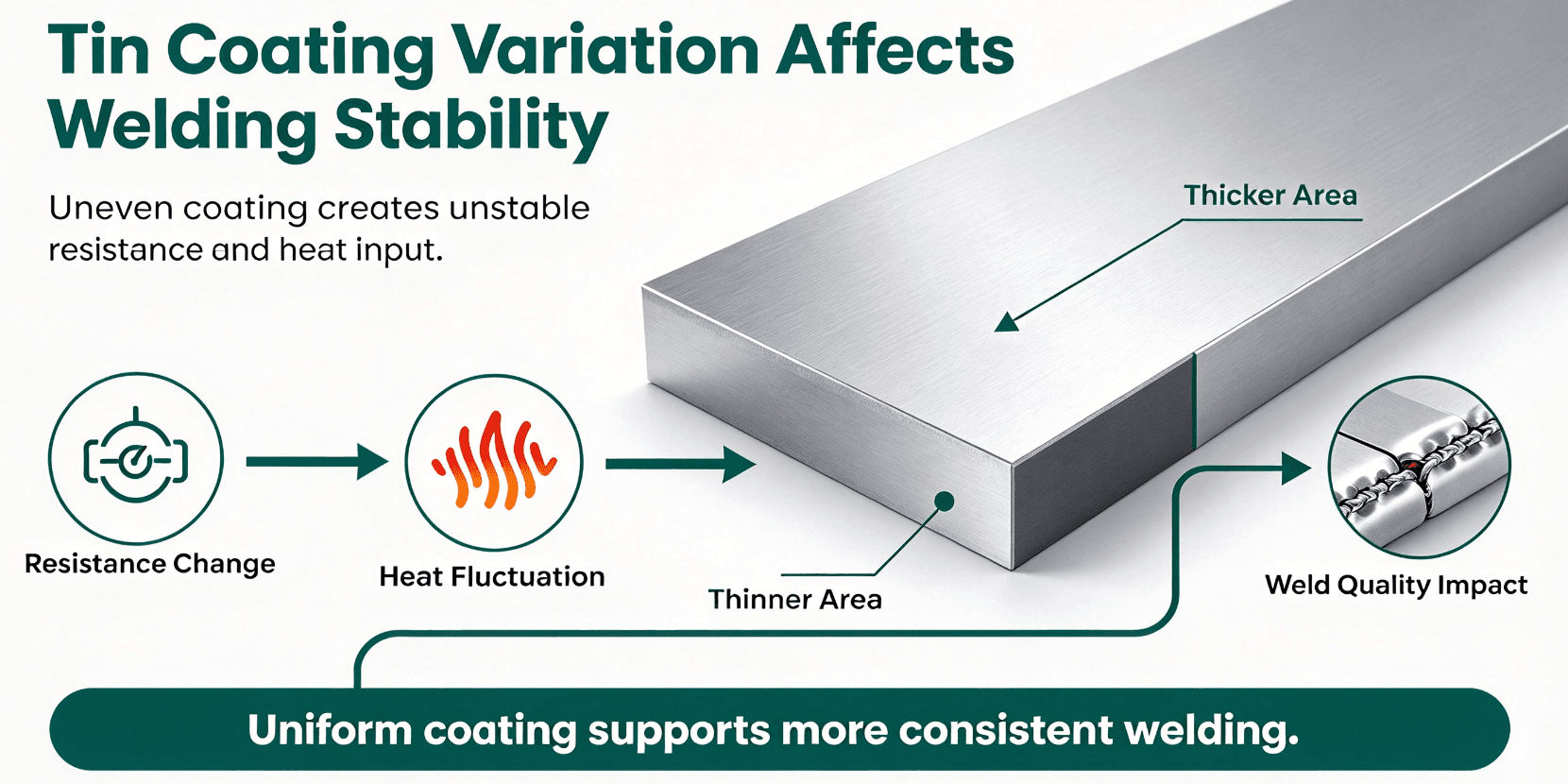
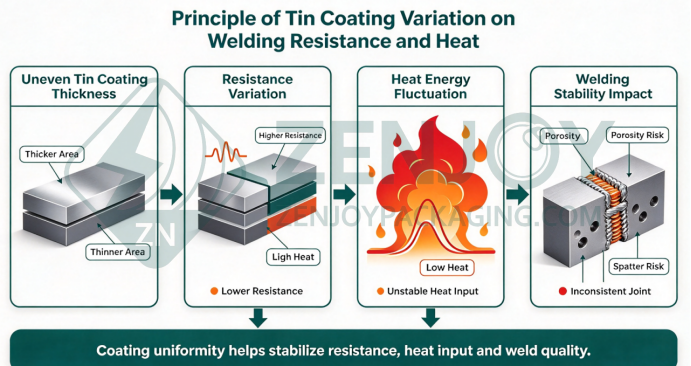
Tin coating serves as both a conductive medium and a thermal buffer during resistance welding. Given tin’s much lower melting point compared with low-carbon steel substrate, any local inconsistency in coating thickness will directly disrupt the stability of contact resistance and Joule heat generation during high-speed lap welding. This unavoidable material fluctuation triggers two typical defective modes: excessive tin causes over-melting and spatter residue, while insufficient tin leads to incomplete metallurgical fusion and hidden leakage risks.
1. Professional Defect Formation Mechanism
Tin coating uniformity includes two critical dimensions: longitudinal consistency along the coil length and transverse uniformity across the strip width. Local coating deviation breaks the unified electrical and thermal conditions required for continuous welding.
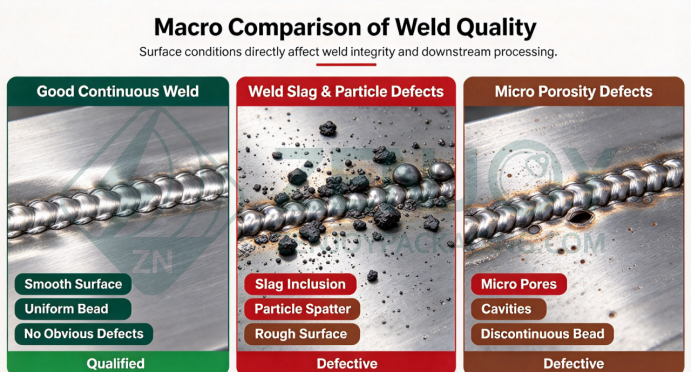
Excess tin coating area (spatter & slag formation): Thickened tin layers reduce interface contact resistance and absorb concentrated instantaneous heat. The tin-iron alloy melts excessively and is squeezed out from the lap gap under welding pressure, forming granular weld slag and splash residue. These defects not only result in rough seam surfaces but also adhere to welding wheels, causing continuous surface scratches and periodic production instability.
Insufficient tin coating area (micro-leakage risk): Local thin tin coverage leads to elevated contact resistance and uneven heat input. The steel substrate fails to achieve complete metallurgical bonding, forming discontinuous weld nuggets and micro-pores. Although such subtle defects may pass conventional offline air pressure testing, they easily fail under high-temperature retort sterilization, resulting in hidden liquid and gas leakage.
Notably, welding parameter optimization (current adjustment, pressure calibration, speed matching) can only compensate for minor process fluctuations. It cannot offset inherent material defects caused by inconsistent tin coating. Poor coating uniformity will inevitably lead to periodic welding quality deviation in long-term mass production.
2. Core Technical Standards for Welding-Grade Tinplate
Stable can welding requires highly homogeneous tin coating distribution across the entire coil. Qualified welding-specific tinplate must maintain tight tolerance in coating weight, eliminating edge thickening, edge thinning and sporadic local thin spots. Continuous and uniform tin coating stabilizes interfacial resistance in every welding cycle, ensures consistent nugget forming, and produces dense, continuous, defect-free weld seams.
Batch-to-batch coating consistency is equally critical. Irregular coating fluctuation between different coils will force frequent welding recipe adjustments, increase trial-scrap volume, and reduce production continuity and yield stability.
3. ZENJOY Professional Sourcing & Quality Control Value
ZENJOY specializes in can-making material supporting solutions. Backed by stable upstream steel mill resources, we focus on refined screening and quality control of welding-grade tinplate. We have established a comprehensive pre-inspection system. For each batch of materials, core indicators including transverse and longitudinal tin coating uniformity, tin coating weight tolerance and batch consistency are rigorously verified. Non-standard coils with severe coating fluctuation that tend to cause welding defects are precisely filtered out. This eliminates material-related welding defects at the source, effectively reducing welding slag, slag leakage and hidden seepage issues. It stabilizes weld seam quality, cuts production scrap, and ensures long-term continuous production with high efficiency and yield rate.
Related News
Other news you might be interested in
Low-Earing CA Annealed Tinplate: The Optimal Material for Stable Twist-Off Lid Deep Drawing & High Yield Rate
Twist-off lid manufacturing has extremely strict requirements on material anisotropy and ductility. Different from regular can bodies, twist-off lids undergo complex deep drawing, edge trimming and crimping processes, making them highly sensitive to uneven steel performance. According to actual mass production verification, no alternative tinplate grades can achieve stable forming results for twist-off lid production. Low-earning CA continuous annealed tinplate remains the most suitable and high-performance material dedicated for twist-off lid stamping.
Deep Drawing Cracking Dilemma: How Tinplate Hardness and Elongation Affect Can Forming
Deep drawing cracking is one of the most common mechanical defects in DRD two-piece cans and complex shaped metal containers. Most stamping failures are not caused by mold parameters or lubrication issues, but by mismatched tinplate hardness and insufficient elongation. Unreasonable material temper selection will lead to edge cracking, body tearing and high scrap rate during high-speed continuous forming.
Want to know more?
Get in touch with us for more information about our services and products.