
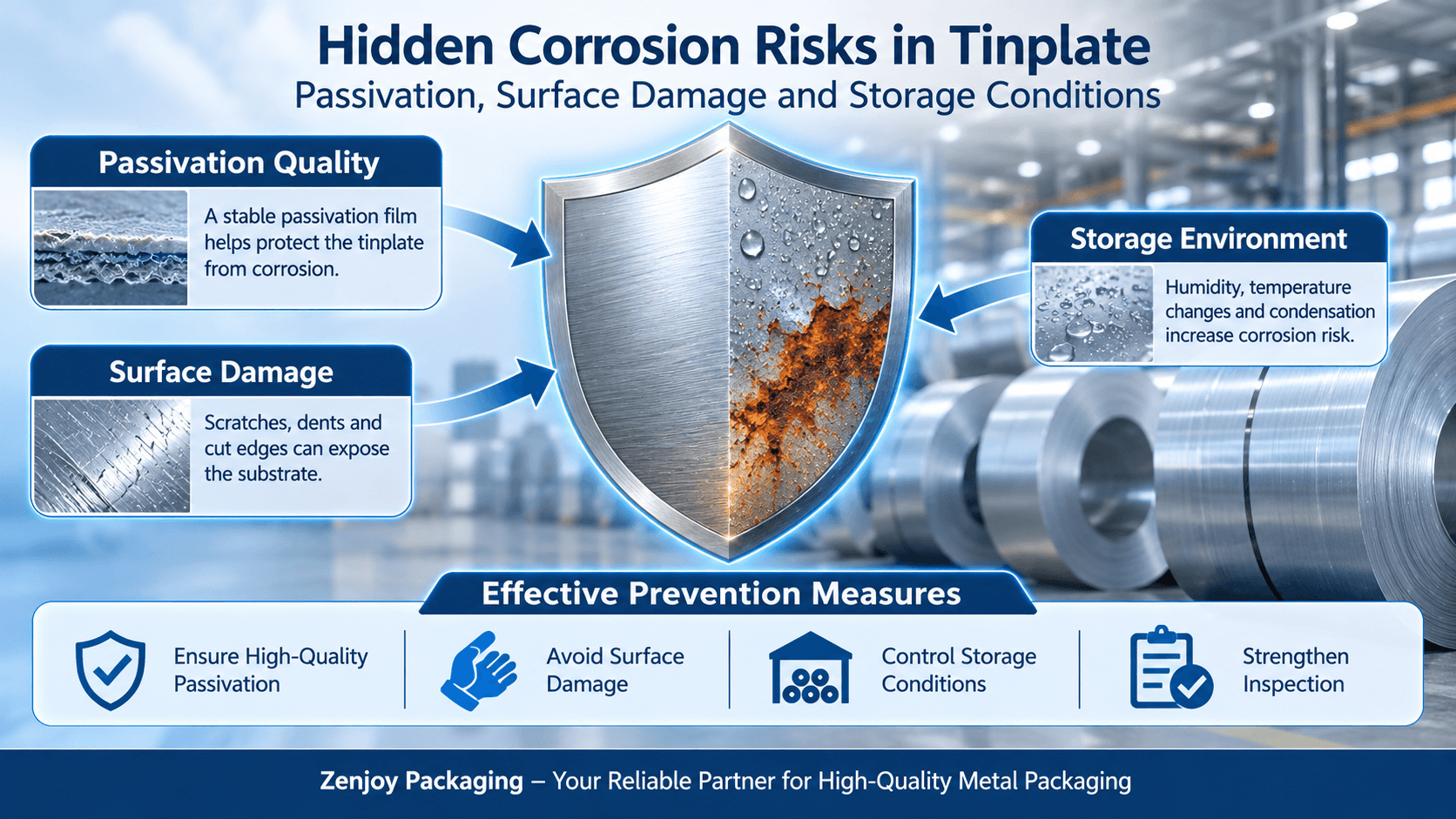
Hidden Corrosion Risks in Tinplate
Tinplate is widely used in food cans, beverage containers, closures, general line cans and industrial packaging. Its performance depends on more than the nominal steel grade or tin coating mass. The finished surface is an engineered system in which the steel substrate, iron–tin alloy interface, metallic tin layer, surface oxide/passivation treatment and any applied oil or organic coating each play a distinct role.
Corrosion complaints are often first noticed as rust spots, water marks, staining or coating defects after slitting, printing, can making, shipment or warehouse storage. It is tempting to attribute these problems to one cause—such as high warehouse humidity or a scratch. In practice, corrosion risk often develops through the interaction of pre-existing surface conditions, local damage and exposure to moisture or contaminants.
This article examines three connected risk factors: passivation quality, mechanical damage and storage environment. It also outlines inspection and prevention measures for material qualification, incoming inspection and warehouse control.
1.Tinplate Is a Multi-Layer Surface System
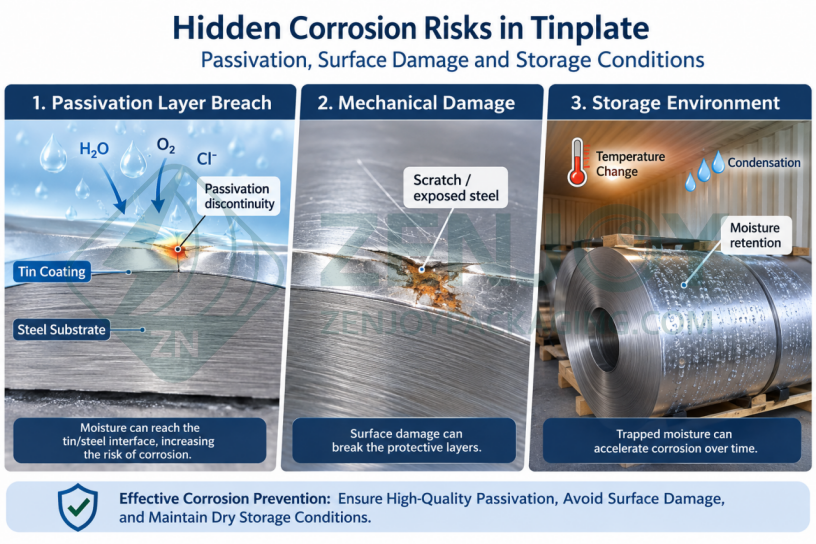
Electrolytic tinplate (ETP) is produced by depositing tin onto a low-carbon steel substrate. Depending on the production route, the tin may be reflowed, followed by chemical or electrochemical passivation and oiling. A simplified surface sequence is: steel substrate → iron–tin alloy layer (where formed) → metallic tin → tin oxide and passivation film → optional oil or subsequent organic coating.
Each layer has a different function. Steel provides mechanical strength; tin provides a metallic surface and contributes to corrosion behaviour; oxide/passivation treatment stabilizes the surface and supports downstream processing; oil helps reduce handling friction and temporary surface exposure. For many packaging applications, a lacquer or polymer coating is subsequently applied and becomes a major barrier between the metal and the packed product.
These layers are not interchangeable. Passivation is not a thick, independent waterproof coating and cannot compensate for a through-thickness scratch, damaged edge, unsuitable internal lacquer or prolonged condensation. A high tin coating mass alone does not guarantee immunity to rust under poor storage conditions.
2. Passivation: A Thin Film with an Important Surface Function
Passivation is a controlled surface treatment applied after tin deposition and related finishing operations. It conditions and stabilizes the tinplate surface. Depending on the specified system, treatment may involve chromium-containing chemistry or chromium-free alternatives. Exact chemistry, film characteristics and regulatory suitability must be confirmed against the mill specification and intended end use.
A properly controlled passivation layer can help reduce undesirable surface oxidation and staining, improve surface stability during storage and handling, and provide a suitable interface for printing inks, lacquers or other organic coatings. Its effectiveness depends on film chemistry, coverage, uniformity, process control and compatibility with the downstream coating system.
2.1 What can go wrong?
· Insufficient or non-uniform treatment: local areas may have weaker surface stabilization, creating variation in staining resistance or coating response.
· Contamination before or after treatment: residual process chemicals, oils, dust or handling residues can interfere with surface consistency and later lacquer adhesion.
· Incompatible treatment and coating system: passivation chemistry not matched to the selected lacquer, ink or curing process may lead to unstable adhesion or inconsistent performance.
· Poorly controlled storage after treatment: moisture and contaminants can still cause staining or corrosion if the package is exposed to condensation or wet conditions.
Passivation quality cannot be adequately judged by visual inspection alone. A surface may appear bright and uniform while differences in surface chemistry or film continuity remain undetected. Qualification should therefore use relevant supplier control data and application-specific tests, not appearance alone.
3.Surface Damage: How a Small Defect Becomes a Corrosion Initiation Site
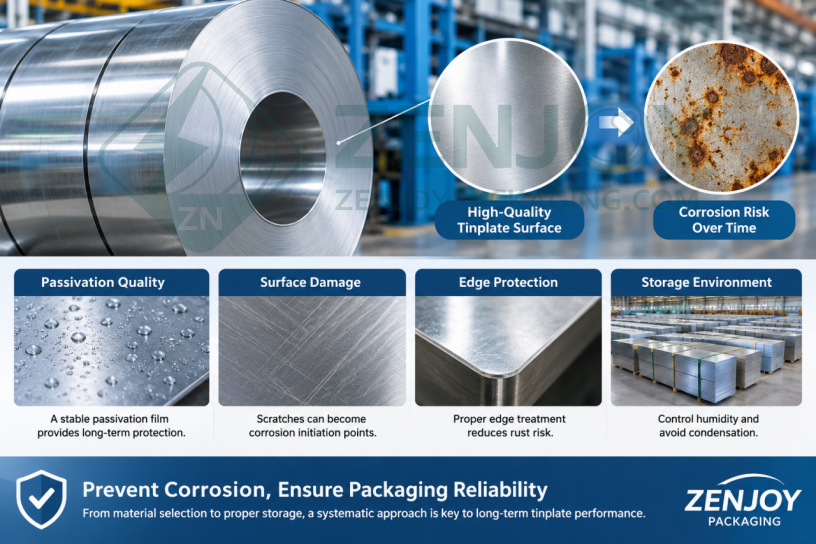
Tinplate is a layered metallic material. A scratch, dent, cut edge, burr or impact mark can locally damage the tin coating and surface treatment. If the damage exposes the steel substrate, the local electrochemical condition changes. In the presence of an electrolyte—such as condensed water containing dissolved salts or contaminants—exposed iron can corrode preferentially relative to the surrounding tin surface, producing localized rust around the defect. Risk depends on damage depth, width and geometry, the surrounding coating condition, moisture availability and exposure duration. A superficial mark that does not penetrate the protective metallic layer is not equivalent to a deep scratch exposing steel. Inspection should distinguish these conditions.
3.1 Common damage sources along the supply chain
· Slitting and cut-to-length operations: damaged tooling, burr formation, poor edge support or metal-to-metal contact can create scratches and edge defects.
· Coil and sheet handling: fork tines, lifting clamps, dragging, unstable stacking and contact with sharp fixtures can damage surfaces or corners.
· Packaging and transport: inadequate edge protection, loose strapping, movement inside the package or water ingress can combine impact damage with moisture exposure.
· Printing and can-making: dirty guides, rollers, tooling, feeding systems or trapped metal particles can score the surface during high-speed processing.
3.2 Why edges deserve special attention
Sheared edges are particularly vulnerable because the cut edge does not retain the same tin-coated surface structure as the broad faces. Edge burrs, exposed steel, poor stacking alignment and damaged edge protection can create sites where moisture is retained. For coils, inspect inner and outer wraps and coil edges; for sheets, check corners, side edges and pallet support.
A useful inspection record identifies defect location, approximate dimensions, whether the defect appears to expose steel, the affected package or coil number, and whether the defect lies within the usable production area. Photographs should include an overall view and a close-up with scale.
4. Storage and Transport: Moisture Is the Key Trigger
Even tinplate with sound surface treatment can develop corrosion or staining if moisture remains on the surface. One common mechanism is condensation: when a cold coil or sheet package is moved into warmer, humid air, the metal may remain below the dew point of the surrounding air. Water can then condense on the surface or inside packaging. Similar conditions may occur during sea freight, port handling, seasonal temperature changes or movement between warehouses.
Risk is not described by relative humidity alone. Surface temperature, air temperature, dew point, duration of wetness, air movement, package integrity and the presence of salts or other contaminants all matter. A single humidity reading at inspection may not reveal a condensation event that occurred earlier.
4.1 High-risk storage and handling conditions
· Placing packages directly on damp floors or close to wet walls, leaking roofs or open loading doors.
· Opening moisture-barrier packaging while the material is cold and the surrounding air is warm and humid.
· Leaving partially used coils or sheet stacks exposed without resealing or protective covering.
· Storing material near washing areas, steam lines, chemical vapours or locations where airborne salts and contaminants may settle.
· Allowing water to enter through damaged wrapping, punctured covers or poorly sealed container packaging.
Avoid exposing cold material to warm, humid air until it has acclimatized sufficiently to reduce condensation risk. The exact acclimatization time is not universal: it depends on package mass, temperature difference, packaging construction and ambient conditions. Follow supplier handling instructions and site-specific procedures.
5. How the Three Factors Reinforce One Another
Corrosion risk is cumulative. A locally weak or discontinuous passivation film may reduce surface stability; a scratch or cut edge may expose steel; and condensation may provide the electrolyte that enables corrosion to proceed. None of these factors should be assessed in isolation.
| Risk factor | Typical weakness | Contribution | Control focus |
| Passivation | Non-uniform film, contamination, incompatible chemistry | Reduces surface stability or downstream coating consistency | Mill process control, agreed specification, surface/coating tests |
| Surface damage | Scratch, dent, burr, exposed edge or steel | Creates a local defect and possible corrosion initiation site | Tooling, handling, edge protection, incoming inspection |
| Storage environment | Condensation, water ingress, prolonged wetness | Supplies moisture/electrolyte and extends exposure time | Dry storage, acclimatization, package integrity, moisture monitoring |
A rust complaint should be investigated as a traceable chain of events. Review material batch and certificate, packaging condition at dispatch and arrival, transport route, container condition, unloading records, warehouse temperature and humidity history, package-opening date, handling events and the location pattern of corrosion.
6. Inspection and Verification: What Should Buyers Ask For?
A robust quality plan combines supplier documentation, incoming inspection and application-specific validation. The objective is not to demand one universal passivation value or test for every product; it is to agree measurable requirements appropriate to the tinplate grade, coating system and intended packaging application.
· Full material designation: steel grade, thickness, temper, tin coating mass on each face, surface finish and applicable standard.
· Passivation system: identify the specified treatment family and relevant supplier-controlled parameters or compliance declarations.
· Surface condition: define acceptable limits for stains, scratches, dents, edge damage, oil residues and other visible defects.
· Traceability: retain coil or bundle number, production batch, inspection record and material certificate.
· Packaging specification: confirm moisture barrier, wrapping, edge/corner protection, pallet support and export packing requirements.
If rust or significant moisture damage is found, segregate the affected package, preserve the original packaging where practical, document the condition before further handling and notify the supplier promptly. Do not automatically mix affected material into normal production. Any decision to use, rework or reject should be based on defect severity, location, product requirements and agreed quality procedures.
7. Application Considerations: One Specification Does Not Fit Every Package
Required corrosion performance depends on intended use. Food cans may face acidic, salty or sulfur-containing products and thermal processing; dry-food and decorative tins may place greater emphasis on external appearance and storage stability; industrial containers may require compatibility with oils, paints or chemicals. Internal lacquer, external coating, can design, forming strain, seam construction and shelf-life target must all be considered.
For food-contact applications, the material and coating system must be assessed against the actual food, process and applicable regulatory requirements. Passivation is not a substitute for a qualified food-contact lacquer or validated finished-package design.
8. Conclusion: Corrosion Prevention Requires a System Approach
Tinplate corrosion is rarely explained by one isolated variable. Passivation quality influences surface stability; mechanical damage can breach the protective surface and expose steel; moisture from condensation, water ingress or unsuitable storage can activate corrosion. When these factors coincide, a small defect can become a visible rust spot, a printing or lacquering problem, or a source of production disruption.
For buyers and can makers, the most effective approach is to define surface requirements clearly, verify supplier controls, inspect packaging and material on arrival, prevent damage during handling, and manage temperature and moisture during storage. Corrosion prevention is a shared quality responsibility across material production, logistics, warehousing and can making.
The real objective is not simply to receive tinplate that looks clean on arrival, but to ensure its surface system remains intact all the way through to its conversion into a dependable finished package. At ZENJOY, we understand that reliable metal packaging begins with material quality and continues through every subsequent stage of handling, storage and processing. Attending to every detail across the supply chain is precisely how we help our customers achieve consistent quality and reliable packaging performance.
Related News
Other news you might be interested in
Build a More Reliable Metal Packaging Supply Chain from Coil to Can
Coordinate tinplate, TFS, can ends, lids, and finished cans through a clearer sourcing plan. Match materials and components to your production line, specifications, and delivery needs.
Build a More Reliable Metal Packaging Supply Chain from Coil to Finished Can
Coordinate tinplate, TFS, can ends, lids, and finished cans with a sourcing plan built around your specifications, production capabilities, and delivery schedule.
Want to know more?
Get in touch with us for more information about our services and products.